Ismael Khalil Gil

What is LeADERS
Learning Through Active Discovery, Engagement, Reflection, and Showcase
LeADERS instructed me that authentic development occurs beyond the act of appearing. It occurs by staying curious, challenging yourself beyond what makes you comfortable, and creating meaning from each experience. Through intentional exploration, being engaged, reflecting, and displaying, I discovered how to integrate service, leadership, and learning into a way of being that feels tangible and enduring. You'll be able to view the evidence of this throughout my portfolio as you see how volunteer event planning, community program support, and working on projects contributed towards developing leadership, communication, problem-solving skills, and teamwork. Yet beyond skills, these experiences influenced the way I view my work in the world not as a professional alone, but as someone dedicated to creating more just systems that honor the people they serve. LeADERS was not merely a program for me. It was a crossroads where I began to learn how to move with purpose, lead from the heart, and remain rooted within the world I aim to improve.

(L)eadership
I gained insights on how organizational leadership, team spirit, and employee motivation contribute towards the effectiveness of an organization during the course of the mandatory class on organizational psychology. The focal point of our assignment was the Chesapeake Care Clinic, where I was able to put theory into practice. Throughout this chapter, I will describe how leadership styles such as transformational leadership, a good team culture, and deliberate communication facilitated the development of a workplace where staff and patients were able to thrive.

(A)cademic Internships
Interning at the Chesapeake Care Clinic was not just about getting hours; it was a turning point around the way I view the health care industry, community work, and my own professional journey. I gained a deeper understanding of what leading, adapting, and serving look like by getting hands dirty through tasks such as patient record management, pantry donation coordination, and mentorship of new interns. In this entry, I will discuss how this internship pushed me beyond where I was before, enhanced leadership, communication, and resilience skills that I possess, and reaffirmed my commitment to working in arenas where access, compassion, and equity are valued.
(D)iversity
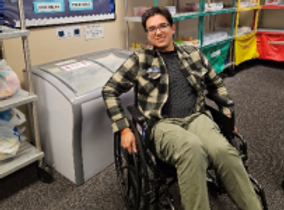
Throughout the 24-hour wheelchair experience, I gained a new appreciation for the day-to-day challenges of individuals with disabilities. It was more than physical barriers, though. It was the social judgment and emotional disconnection they face. It challenged me as a person and as a professional to think about accessibility, empathy, and ethical citizenship. In this section, I'll write about how the experience changed the way I think about healthcare, equity, and the duty of advocating for inclusive transformation.
_jfif.jpg)
(R)esearch
I examined if time invested in extracurricular activities had any impact on the effective management of stress among students. While the results did not confirm my initial hypothesis, the experience provided me with the skills of designing a piece of work, interpreting evidence, and thinking outside the results. In the following section, I shall explain how developing a habit of approaching work as a researcher through curiosity, patience and a positive mind enhanced me as a learner as well as a professional.
_jfif.jpg)
(S)ervice Learning
During my internship with ODU's Alternative Spring Break program, I worked alongside peers to deepen our understanding of service, leadership, and community engagement. Through hands-on volunteer work with local nonprofits and survey analysis afterward, we saw real growth in connection, comfort across differences, and long-term commitment to giving back. In this section, I will share how service learning shaped my approach to leadership, community building, and professional development.

Personal Statement
I’m a first-generation health services administrator and incoming MPA candidate who is motivated by a dedication to equity, cooperation, and evidence-based impact. I am convinced that effective change occurs when nonprofits, small businesses, and community leaders align towards common purposes on the basis of open decision making and people-centered design. I’m committed to creating partnerships that simplify operations, amplify the voices of the underserved, and create healthier and more resilient communities.
Career Aspirations
I want to make a difference for nonprofits and small businesses by solving actual problems for actual people. Streamlining operations, cutting through decisions, and making every dollar count will enable me to get the programs where they have the most impact. I will use my health services experience to listen carefully to the community, forge authentic partnerships, and develop something that lasts. I mark success by the revitalized neighborhoods, enhanced lives, and teams motivated to keep striving.

Work Samples
(L)eadership
Organizational Psychology at Chesapeake Care Clinic
Leadership stands as the most significant ability for anyone pursuing degrees within health services, the non-profit world, or public administration. Leadership within these realms involves more than the title. It involves establishing trust, managing change, and motivating individuals to work towards a common goal. That's why courses such as Organizational Psychology were integrated into my curriculum at ODU. I was able to learn firsthand what leadership did for actual organizations through working on a project at the Chesapeake Care Clinic. We examined how transformational leadership at the clinic created teamwork, motivation, and resilience within a facility of limited resources but infinite heart. It was amazing to observe how leadership principles of the strongest kind turn challenges into opportunities for expansion and relationship building.
This experience was far more than a class assignment for me. It provided a template for the type of leader I strive to be: one who leads for a purpose, builds trust through actions, and places the mission at the forefront of every choice. The teachings of this class did not remain relegated to the confines of one room. They influenced the way I mentored a new intern while I was at Chesapeake Care, the way I managed volunteers while on Alternative Spring Break, and the way that I engage each team on which I work today. Leadership has long remained a common thread throughout the fabric of college experience, binding together all of the things I have done and preparing me to take on the roles where leading by compassion, clarity of purpose, and strategy will make the difference.
(A)cademic Internships
Chesapeake Care Clinic
Interning at the Chesapeake Care Clinic was one of the most defining aspects of college. I went into the internship expecting solely to gain hours and fulfill requirements, but what I got was something much more. It was a time when I was able to work hands-on with patient records, help coordinate donations, and even train incoming interns, all of which required me to take on a level of responsibility I previously thought unimaginable. Through this experience, I gained a sense of how health care nonprofits work behind the scenes, the importance of attention to details within health documentation, and the level of flexibility and quick problem solving required of us when approaching diverse community needs. Daily at the clinic was a new lesson on healthcare, leadership, and the need to show up both skilled and compassionately.
This internship experience also allowed me to relate my academic learning to impact beyond the classroom. It refined skills I was developing within the context of classes such as communication, organizational skills, and problem-solving, while also broadening me as a person as relates to resilience, compassion, and self-confidence. Working among professionals who genuinely felt invested in the mission demonstrated to me that teamwork is not merely the completion of tasks, but the contribution towards something bigger than yourself. The experience I gained within the time period at Chesapeake Care directly applies towards the career goals I plan on pursuing within the realm of public service and non-profit management where a consideration of community needs and a people-centric philosophy will always be at the forefront of what I do.
(D)iversity
24-Hour Wheelchair Experience
My 24-hour wheelchair experience was one of the most eye-opening parts of my experience at ODU. It was designed as a simulation of the physical and social barriers experienced by people living with mobility impairments, but what I gained was beyond what I expected. Navigating nondisabled spaces as a wheelchair user made me observe obstacles I had previously gone unnoticed, but deeper was the feeling of being perceived by the people around me. Moments of dis/ability-based judgment and misunderstanding educated me about the level to which dis/ability attitudes are embedded, and the work of authentic empathy as a path of access and inclusion. This experience reminded me that diversity work isn't about recognizing difference, it's about recognizing lived reality and creating actual transformation.
I am sure this experience will have a long-term impact on my professional growth. As a professional entering health services and public administrations, I will have to promote inclusive policy and accessible service as well as spaces where people are treated with respect. It's not merely about responsive paperwork compliance with things like the ADA. Leadership means listening and responding and creating systems that actually work for diverse populations. Having done this work required me to build emotional resilience, ethical awareness, and a reflective examination of the ways good-intentioned systems displace people. Those lessons will follow me as I build a career centered around equity, service, and creating places where all people might flourish.
(R)esearch
Coping and Extracurricular Activities Study
Through my HLSC/PUBH 445 research project, I investigated the correlation between extracurricular participation and the ability of students to manage stress. I began by hypothesizing that students who invested more time in extracurricular pursuits would have better coping mechanisms, but the results disagreed. Although the results were not as expected, the experience did me a far greater good. It revealed the value of thinking analytically about the design of the research, objectively examining the facts, and coming to terms with the fact that good research involves discovery rather than confirmation. Negotiating the obstacles of a small sample size, self-reported information, and unanticipated results allowed me to develop patience, versatility, and a greater appreciation for the research process.
This experience allowed me to have a stronger basis for the career on which I am focused. In health services and public administration, decision making through data is fundamental. Having the ability to plan a study, interpret trends, and know the practical implications of numbers will enable me to support programming and policy that actually serves community needs. The research experience also tied into other abilities that I constructed at ODU, such as critical thought on leadership projects and communication on service learning. All of these experiences enabled me to develop into a professional who not only appreciates evidence-based practice, but also knows how to interpret numbers from a people-centered point of view.
(S)ervice Learning
Alternative Spring Break at ODU
Participating in Alternative Spring Break at ODU was one of the most impactful service experiences throughout my college career. As an intern, I assisted in planning a week of volunteer work at a series of nonprofits throughout the Hampton Roads community. Through hands-on service work, reflective discussions, and analysis of survey feedback, I observed how community service deepened feelings of belonging, leadership, and civic responsibility among the students. It was tremendous to observe not just how our work benefited the nonprofits where we volunteered, but also how the students became more connected with one another, ODU, and the broader community. Learning through service showed me that true social change occurs where education and action meet.
This experience directly relates to my long-term career aspirations for work in public service and nonprofit management. It helped me learn how to work within diverse populations, be responsive to community needs, and lead humbly and purposefully. It added on top of the leadership and teamwork abilities I gained working at the Chesapeake Care Clinic and through organizational psychology coursework. Most importantly, it made me understand that career success isn't about individual accomplishment. It's about creating systems on behalf of people that promote collaboration as well as make a tangible difference within the communities engaged. It reaffirmed for me the values of a career centered on impact, integrity, and inclusion.